
• Home
  • About Diana Telfer
    ▼
    • FAQs
  • Family Law
    ▼
    • Collaborative Divorce
    • Mediation
    • Premarital Agreements
    • Limited Representation Services
    • Child Custody/Child Support
    • Alimony
    • Negotiated Settlements
    • Special Master
  • Blog
    ▼
    • In The News
  • Schedule an Appointment
  • Pay Online
  • Skip to primary navigation
  • Skip to main content
  • Skip to primary sidebar
  • Skip to footer

Telfer Family Law & Mediation

Salt Lake City Divorce & Mediation

phone number
801-464-4004

  • Home
  • About Diana Telfer
    • FAQs
  • Family Law
    • Collaborative Divorce
    • Mediation
    • Premarital Agreements
    • Limited Representation Services
    • Child Custody/Child Support
    • Alimony
    • Negotiated Settlements
    • Special Master
  • Blog
    • In The News
  • Schedule an Appointment
  • Pay Online

Money Conversations

Designing Our Future: A Thoughtful Tool for Relationship Planning

February 24, 2026 By Diana Telfer

Talking about money, expectations, and long-term plans can feel overwhelming for couples — especially when those conversations are tied to legal agreements like prenuptial or post-nuptial planning. Many people want to approach these discussions with care but simply do not know where to begin.

That is where the Designing Our Future workbook can make a meaningful difference.

Starting with Values, not Legal Terms

Rather than jumping straight into legal language, the workbook helps couples begin where strong relationships are built: shared understanding. Through guided prompts and structured exercises, partners explore their beliefs, priorities, and hopes for the future.

The focus is not on “who gets what,” but on questions like:

  • What does financial partnership mean to us?
  • How do we make decisions together?
  • What responsibilities do we carry toward family, children, or past commitments?
  • What helps each of us feel secure and respected?
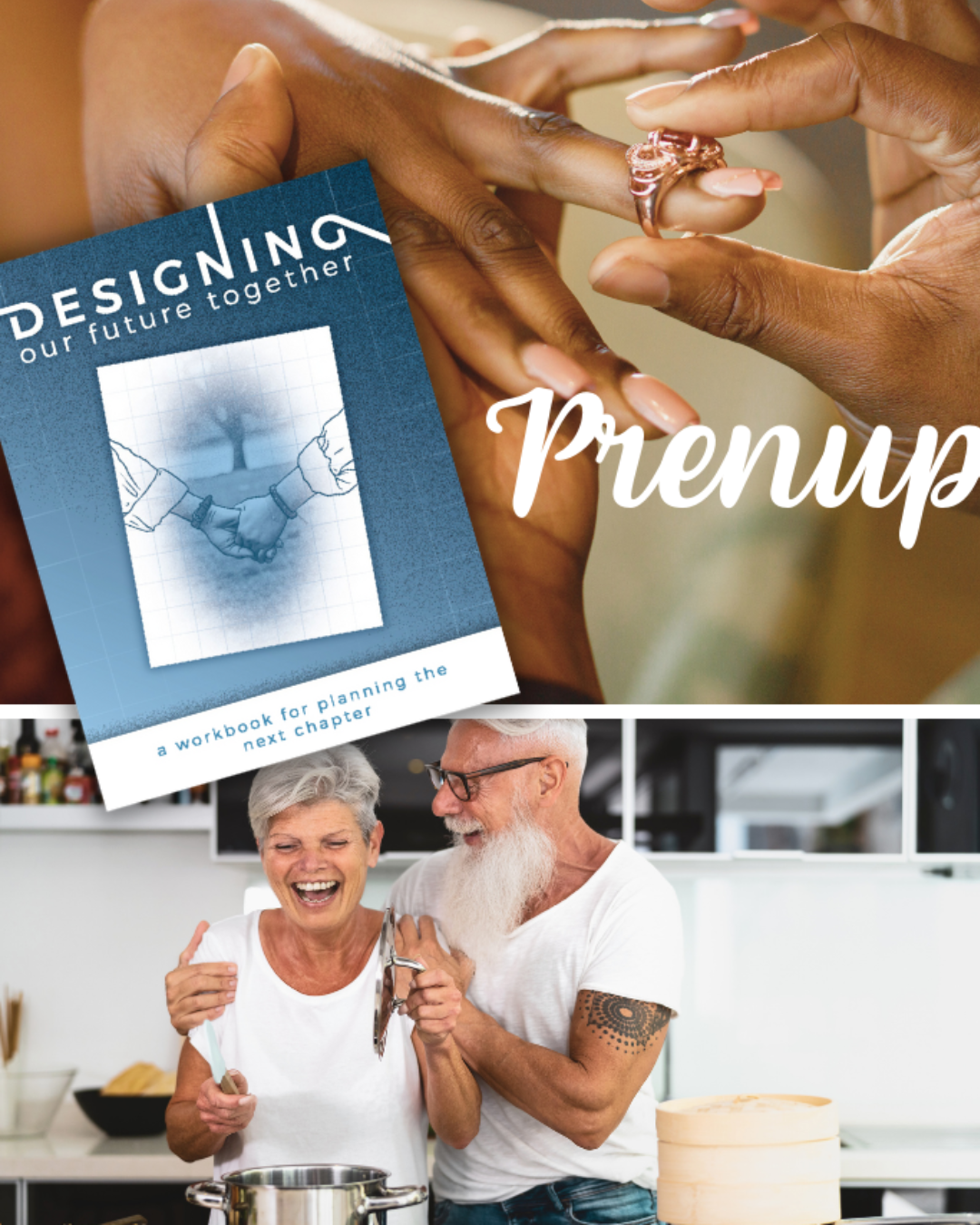
By the time legal planning enters the picture, couples have already built a foundation of clarity and empathy.

Slowing down in a good Way

Legal conversations can sometimes feel rushed or emotionally charged. A structured workbook slows the pace and creates space for reflection. Each partner has time to think, respond, and listen without feeling pressured to have immediate answers.

This slower, more intentional process often reduces defensiveness and helps partners feel like they are working together rather than negotiating against each other.

Supporting healthier Agreements

Whether couples are considering a prenup, a post-nup, or simply wanting greater alignment in their financial life, the workbook supports more thoughtful decision-making. Agreements that grow out of shared reflection tend to feel fairer and more sustainable because both people have been part of the conversation from the beginning.

In this way, the workbook is not just a preparatory exercise. It is a relationship tool that strengthens communication, deepens mutual understanding, and supports planning grounded in care.

I have been using this resource for three years. And it supports my intention that thoughtful planning begins with thoughtful conversations. Tools like Designing Our Future help couples approach important decisions with clarity, respect, and a shared vision for the life they are building together.

With Care,

Diana

Filed Under: Prenups & Marriage Agreements Tagged With: Money Conversations, Prenuptial Agreements

How matters as much as What

February 24, 2026 By Diana Telfer

The Emotional Impact of the Prenup Process

When people think about prenuptial agreements, they usually focus on terms:

  • who keeps what,
  • how property is handled,
  • what happens in worst-case scenarios.

But in many relationships, the emotional impact of how the agreement is created lasts far longer than the specific legal provisions inside it.

A thoughtful process can deepen trust. A rushed or one-sided process can quietly damage it before the marriage even begins.

Why Surprise Prenups undermine Trust

Few things feel more destabilizing than a last-minute legal request tied to a wedding.

When one partner introduces a prenup unexpectedly — especially close to the wedding date — the other may feel blindsided, pressured, or emotionally cornered. Even if the intention was practical, the impact can land as mistrust: Why are you bringing this up now? Do you not feel safe with me?

Trust erodes not because of the agreement itself, but because the process feels unilateral rather than shared.

A prenup should never feel like a test to pass. It should feel like a conversation both people are choosing to have.

Timing matters more than People realize

The best time to begin talking about a prenuptial agreement is early enough that neither person feels trapped by logistics, deposits, or social pressure.

Good timing allows for:

  • Space to reflect without urgency
  • Time for both partners to seek independent advice
  • Emotional room to ask questions without fear of derailing the wedding

The worst time? When invitations are sent, families are traveling, and the emotional and financial momentum of the wedding makes it hard to say, “I need more time.”

Pressure distorts consent. Thoughtful timing protects it.

Recognizing Power Imbalances

Every couple brings different forms of power into a relationship. Sometimes it is financial for example when one partner earns significantly more or comes from family wealth. Sometimes it is structural like immigration status, visa dependence, or limited access to resources. Sometimes it is emotional, meaning that one partner feels more invested in the wedding timeline than the other.

These imbalances do not make a prenup wrong. But ignoring them can make the process unfair.

A respectful process asks:

  • Does each person have a meaningful opportunity to understand and negotiate?
  • Does anyone feel they must agree to avoid losing the relationship or stability?

Fairness is not only about the outcome on paper. It is about whether both people had a real voice along the way.

How Collaborative and Mediation-based Approaches help

Traditional adversarial negotiations can trigger defensiveness. This manifests in each lawyer advocating strongly for one side, resulting in positions hardening, and conversations narrowing to risk and protection.

Collaborative and mediation-based approaches help to shift the tone.

They encourage:

  • Joint conversations about goals and concerns
  • Problem-solving rather than posturing
  • Language that focuses on mutual care, not worst-case narratives

When couples feel they are working together to design an agreement, rather than bracing for a legal battle, the process can actually strengthen communication skills they will rely on in marriage.

The Long-Term Cost of Agreements made under Pressure

An agreement signed under emotional pressure may be legally valid, but still carry relational cost.

Resentment can linger if one partner feels they had no real choice. That unspoken hurt may surface later during unrelated conflicts: money decisions, career sacrifices, or family planning. What was once a document becomes a symbol of imbalance.

By contrast, agreements reached through patience and transparency tend to feel like shared decisions. Even years later, couples can say, “We talked about this. We chose this.”

Why Fairness and informed Consent matter more than “airtight” Terms

Some people approach prenups with one goal: make it legally bulletproof. But an “airtight” agreement that one partner experienced as confusing or coercive can fracture trust.

An agreement built on informed consent, mutual understanding, and a sense of fairness is more likely to hold emotionally and legally. Courts often look at process as well as substance. Relationships certainly do.

The strongest agreements are not the ones that anticipate every possible dispute. They are the ones both partners can live with, and most of all, stand behind without feeling diminished.

Tools that Support better Conversations

Structured resources can make these discussions less overwhelming. A guided tool like the Designing Our Future workbook (that I am using in my practice) can help couples explore values, expectations, and financial philosophies before those ideas are translated into legal language.

When couples start with shared reflection instead of immediate legal drafting, the resulting agreement often feels more aligned and less intimidating.

A respectful process builds agreements that last because they honor both people, not just the paperwork. In prenuptial planning, how you get there shapes not only the document you sign, but the relationship you are building along the way.

With Care,

Diana

Filed Under: Prenups & Marriage Agreements Tagged With: Money Conversations

Love and Clarity: Rethinking Prenuptial Agreements

February 17, 2026 By Diana Telfer

Prenups as an Act of Care:
Why Planning doesn’t mean you expect Things to end
There are few topics that can change the emotional temperature of a room as quickly as the word prenuptial or “Prenup”. For many couples, it carries a quiet sting — a fear that bringing it up somehow predicts failure or reveals doubt.

But what if that reaction is based more on cultural myth than relational reality?

The Myth: Prenups mean Distrust
We have inherited a story that says: If you really believed in us, you would not need a prenup. That story sounds romantic. It is also deeply misleading.

Healthy relationships are not built on avoiding difficult conversations. They are built on the ability to have them with honesty and care. A prenuptial agreement does not signal an expectation that love will end. It signals a willingness to talk openly about the practical parts of building a life together.

In truth, silence about money, debt, expectations, or family obligations is far more likely to erode trust over time than a thoughtful planning conversation ever could.

So, let’s use a different Frame: A Conversation about Values
At its best, a prenup is not a stack of legal protections. I see it as a structured conversation about what matters most.
It invites couples to talk about questions like:

● How will we make financial decisions together?
● What responsibilities do we each carry into this marriage?
● How do we want to handle generosity toward extended family?
● What does financial partnership mean to us?

They might appear as legal questions. But they are not – they are values questions. The legal document simply records the clarity the couple creates together.

The Cost of avoiding “Money Talks”
Many couples glide into marriage with enormous goodwill and very little shared understanding about finances. They assume they will “figure it out later.” Unfortunately, “later” often arrives during moments of stress, like job changes, children, illness, or unexpected financial strain.

When expectations have never been voiced, partners may interpret differences as betrayal rather than misunderstanding. What could have been a calm early conversation becomes a conflict loaded with emotion and hurt.
Avoidance does not protect love. It postpones tension until it is heavier.

Fear-Based Prenups vs. Values-Based Planning
Let me illustrate fear-based prenups vs. values-based prenups.

A fear-based prenup often sounds like:
● “I need to protect myself from you.”
● “I have seen marriages fail, and I do not want to be vulnerable.”
● “Let us lock everything down just in case.”

A values-based prenup sounds different:
● “Let us talk about how we want to treat each other, even in hard seasons.”
● “Let us make sure neither of us feels financially powerless.”
● “Let us decide together what fairness looks like for us.”

The tone, the process, and the spirit behind the agreement matter as much as the terms themselves. One approach builds walls. The other builds understanding.

Why Couples often feel more secure afterward
Many of my clients are surprised to learn that many couples frequently report feeling closer after completing a thoughtful prenuptial process.
Why? Because they have practiced something essential to long-term partnership:
● Listening without defensiveness
● Naming fears without blame
● Making decisions collaboratively
● Seeing and being seen in vulnerable conversations

Clarity reduces anxiety. When both partners know where they stand and feel heard in the process, uncertainty shrinks and security grows.

Protecting the Relationship, not just Assets
The process used to create a prenup can either strain a relationship or strengthen it. A respectful, transparent approach — where both partners have support, space to reflect, and a voice in the outcome — helps protect the relationship itself.

When the focus is on mutual care rather than leverage, the agreement becomes less about dividing property and more about building a foundation of trust, honesty, and shared intention.

In that sense, the process is not a legal hurdle before marriage. It is an early exercise in the very skills a strong marriage requires.

Speaking from many years of experience, a prenup done well is not about preparing for divorce; it is about caring enough to talk about hard things early.

It is an act of clarity, respect, and love — choosing transparency now so that the relationship can grow on solid ground later.

With Care,
Diana L. Telfer

Filed Under: Prenups & Marriage Agreements Tagged With: Business Ownership, Money Conversations, Postnuptial Agreements, Prenuptial Agreements

Primary Sidebar

"*" indicates required fields

Let’s Connect
801-464-4004
Preferred Method of Contact

From The Blog

Testimonials

Diana Telfer is the best attorney I could have asked for. She listened to all of my concerns and gave me the realistic outcomes of what would happen in court. She genuinely cared for my daughter and I, and fought tooth and nail for us. She’s extremely well organized, considerate, communicative, and professional. She is consistently staying updated on your case to ensure you have everything you need when going to court. She also makes you very aware of how much everything will cost and gives you the best for your money which I greatly appreciated. She has worked for me for two years now and I have zero complaints. Her and her team are the best, and definitely who you want on your side of the court room. I will recommend her to everyone because she was the blessing my daughter and I needed during a trying time in our lives.

Footer

Telfer Family Law & Mediation
1825 South 700 East,
Salt Lake City, UT 84105
801-464-4004

Copyright © 2026 - All Rights Reserved | Web Design by The Crouch Group | Log in